Ray Perry Armstrong
Ray Perry Armstrong was the 1st child of Ray T. Armstrong and the 1st child born to Violet Worthington. Ray Perry was born 21 Sep 1914 in Fort Worth, TX. Ray Perry married Ercell Maxine Burrus on 28 Nov 1935 at the age of 21 and they had 1 child and married Kathrine A. Thomas on unknown at the age of ???. . Ray Perry died 24 Apr 1945 at the age of 31.
Navigable Family Tree
Biography/Pictures
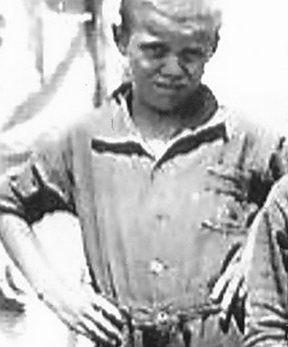
Ray Perry Armstrong, or Perry as he was called, was born 21 September 1914 in Fort Worth, Tarrant County, Texas to Ray Terrell Armstrong and Violet Worthington. Perry was the oldest of four boys.
Perry may have attended Central High School in Fort Worth since Tom, his younger brother by two years, went there. According to the 1930 US Census, Perry worked as a waiter at a lunch store in Fort Worth.
Perry married Ercell Maxine Burrus on 28 November 1935 in Marietta, Love County, Oklahoma. They had one child together, Dolores Ann Armstrong. Their marriage lasted only a short while and sometime before 1940 they were divorced.
When Perry enlisted in the US Army on 29 May 1942 at Long Beach, California he was 5 feet 6 inches tall and weighed 173 pounds. He had blue eyes, brown hair, had a light complexion, and wore a size 8C shoe. Before that, he had been working as a labor foreman in a ship yard earning $68.00 a week. He designated his daughter, Dolores A. Armstrong, as beneficiary on his life insurance with both of his parents listed as alternate beneficiaries.
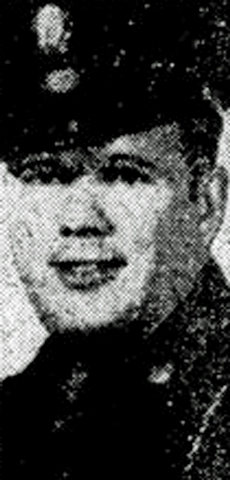
Upon induction on 29 May he was sent to Camp Stoneman near Pittsburg, California for training. After completing basic training, in August 1942 he was assigned to the military police and promoted to corporal at Camp Stoneman. In November, he was advanced to the rank of sergeant. It appears that while he was stationed at Camp Stoneman he married Ms. Katherine A. Thomas. By January 1943 he was serving as a provost sergeant and by May of that year he was a Duty NCO.
He left Camp Stoneman in September 1943 and went to North Carolina for two weeks before being sent to Guadalcanal where he arrived October 15, 1943. At that time, he was officially reassigned to Co B, 145th Infantry serving in the Pacific. He stayed in Guadalcanal for a month before being sent to Bougainville in the British Solomon Islands where he spent the next year.
Like many of the soldiers in the Pacific, sickness and fighting were a way of life. He received a bronze battle star on 12 December 1943 shortly after arriving at Bougainville. On 12 January 1944, he was hospitalized with malaria for 5 days. In March, he was involved in combat with the enemy and sustained his first wound due to combat. On 27 April 1944, he received his first Purple Heart "For wounds received in action against the enemy at Bougainville, Solomon Island on 10 March 1944". He would later be awarded a posthumous Bronze Star Medal for actions that occurred the following day: "For heroic achievement in connection with military operations against the enemy at *****, Solomon Islands, 11 March 1944. Staff Sergeant Armstrong, without regard for his own injury assisted in evacuating four men of his squad and returned to lead the remainder of his squad in continued assault. By this action additional pillboxes were occupied, and an enemy counterattack repelled."
On May 29 1944 he was seen by the local corpsman for flu-like symptoms. The corpsman sent him to the 112th Combat Station where he was admitted on 7 June with amoebic dysentery. This time he was hospitalized for 6 days. After a little over a week back with his squad he was back in the hospital on 20 June for another ten days. This time the diagnosis was hookworms.
The battle for Bougainville continued in full scale for almost the entire year. While we don’t have records detailing what conflicts and roles Sgt. Armstrong participated in during this time, rest assured that the fighting was almost non-stop. What we do know is that he was hospitalized again on 17 October 1944 with acute hemorrhoids which caused him to be in the hospital for at least two days.
In addition to the Purple Heart he received while at Bougainville, he received two overseas service bars (each bar represents 6 months of service outside the United States), a Combat Infantryman Badge, and a Good Conduct Medal.
By November 1944 the first phase of the Allied campaign in the South Pacific at Bougainville finished. Thus, now Staff Sergeant Armstrong was moved to Luzon in the Philippines, arriving there on the 10 January 1945. His division participated in the capture of Clark Field in January and then moved on toward Quezon and the Parian Gates.
On 7 February 1945 while fighting against the enemy at the Pasig River, SSgt Armstrong received combat wounds when Japanese shell fragments struck him in the leg. The wounds were serious enough that he was medevacked to a military hospital in New Guinea on 10 February. He stayed there until 13 February.
A posthumous Silver Star Medal dated 14 May 1945 described his next encounter with the enemy. “For gallantry in action at ****, on 18 February 1945. When the squad led by Sergeant Armstrong attacked a strong enemy emplacement, it met heavy machine gun fire which seriously wounded two men. The casualties were lying in an exposed position and Sergeant Armstrong realized that immediate evacuation was necessary. Placing the remainder of his squad in a covered position, he personally crawled into the clearing, administered first aid, and aided the two men in reaching a position of safety, although hostile fire from the Japanese emplacement swept the area. After supervising the evacuation of the wounded men, Sergeant Armstrong rejoined his squad and led it in an attack which successfully reduced the enemy position.”
Upon returning to the front lines on February 21st, he was engaged in fighting at the Walled City portion of Manilla when he was again wounded. The citation for the Purple Heart Oak Leaf Cluster states, “For wounds received in action against the enemy on 21 February 1945, in Walled City, Manila, Luzon, Philippine Islands.” His medical records show that he received a penetrating wound to lateral surface of his left forearm from enemy shell fragments on 21 Feb 45 at Walled City, Manilla. Hospital notes state “on Feb 21, 1945 at 1830 hrs. outside Walled City (Manila) Jap grenade hit right thigh, bounced off and exploded 6 feet away. He laid flat on ground and only received shrapnel wounds to left forearm. Upon examination, the doctors found two small pieces of shrapnel – one a pinpoint, the other the size of a millet seed. The wounds were closed on 24 Feb and by 27 February the wound had healed leaving a scar about the size of a pea.” He was returned to duty on February 28.
In March 1945, he earned another overseas service bar which meant he had now been in the Pacific combat area for 18 months. Between the fighting and medical issues, it seems there was not much time for leisure. On April 7, he was again sick. The corpsman thought he might have Dengue Fever and he was eventually sent to a military hospital, arriving there on 8 April. In the end, it was determined he had nasopharyngitis which kept him hospitalized for eight days.
He returned to the front lines by mid-April and returned to his duties as a squad leader. At about the same time the main part of the Division was split off and moved to the northern part of the island for operations, leaving the 145th Infantry to finish the operations around Manilla. A little over a week later, on 24 April 1945, SSgt Ray Perry Armstrong was killed in action by enemy mortar fire while participating in an attack on Japanese positions on Mount Pacawagan, Luzon, Philippine Islands.
He is buried in plot D, Row 14 Grave 90 at Fort William McKinley at Manilla. The military awards he received during his nearly three years in the Army include:
- Silver Star Medal
- Bronze Star Medal with Oak Leaf Cluster
- Purple Heart with Oak Leaf Cluster
- Good conduct Medal
- Combat Infantryman Badge
- World War II Victory Medal
- Philippine Liberation Ribbon with bronze star
- 3 Oversea Service Bars
References
Last data update: May 29, 2025
1920 United States Census Document, Bella Township, Comanche County, Oklahoma; Enumeration Date: Jan 2, 1920, page 2, lines 18-22 Citation post date: 2009-07-06
Personal genealogical research information and notes provided by Anita Jeane Armstrong , Email dated 2/11/2018 Citation post date: 2025-05-28
Personal genealogical research information and notes provided by Mary Lounell (Cook) Robinson, Email dated 2/11/2018 Citation post date: 2006-08-26